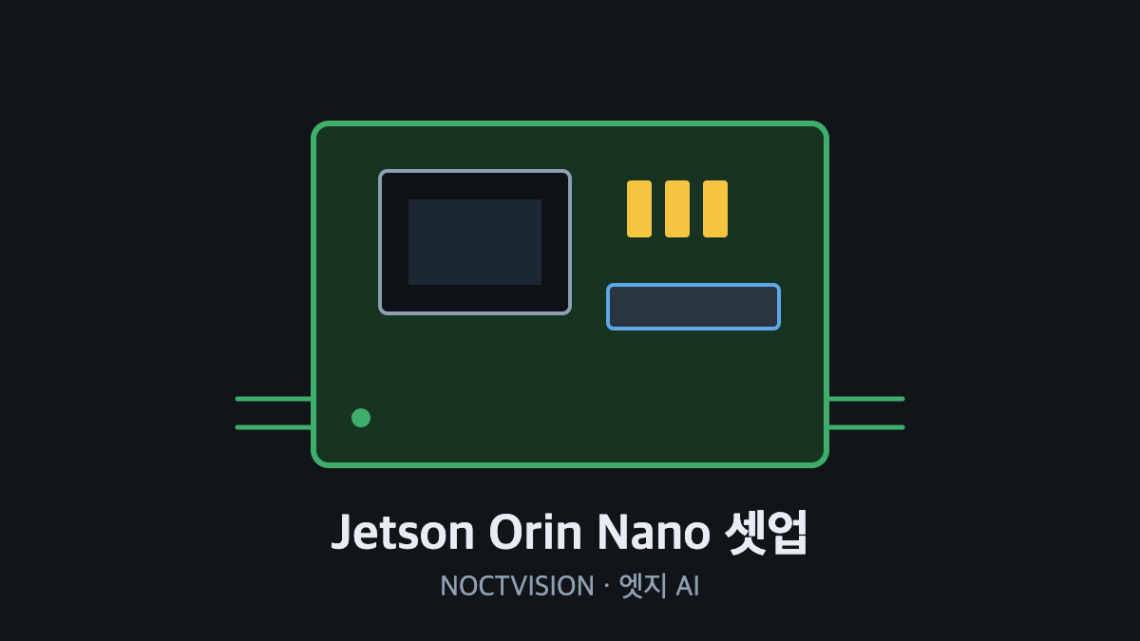
Four Snags in Initial Jetson Orin Nano Setup
The first time I powered on the Jetson Orin Nano Super developer kit, nothing showed up on the screen. I assumed it was a cable problem and swapped a few, but it didn’t help.
Cutting to the conclusion: it wasn’t a board problem, it was a misunderstanding of the output method. This piece lays out, in order, the points where initial setup tends to get stuck.
What You Need Before You Start
| Item | Notes |
|---|---|
| DisplayPort cable or an active adapter | There’s no HDMI port. Explained below |
| USB keyboard/mouse | Needed for initial setup |
| microSD or NVMe SSD | Boot media |
| Power adapter | Make sure capacity is sufficient |
| Wired LAN or wireless module | Needed for updates |
First Snag — No Video Output
There’s No HDMI Port
The Orin Nano developer kit’s video output is a single DisplayPort. Using an HDMI monitor requires conversion, and this is a common place to get stuck.
A passive adapter won’t work. Cheap DP-to-HDMI genders just pass the signal through as-is, and in many cases that simply doesn’t work. You need an active adapter with a chip inside.
Connecting directly to a monitor with a DisplayPort input, if you have one available, is the most reliable option.
When It Boots but There’s Still No Video
If the power LED is on and the fan is spinning but there’s no video, the board is alive. In that case, check two things.
- Whether the board picked up an IP address in your router’s admin screen — if it did, networking is fine and only the video output is the problem
- Whether SSH is reachable — if it is, you can keep working without a monitor at all
If SSH is open, there’s no need to keep wrestling with a monitor. Working remotely is faster.
Second Snag — Firmware
The board holds boot firmware in a QSPI region. If that firmware version doesn’t match the JetPack version you’re trying to install, boot either doesn’t proceed or stalls partway through.
Out-of-the-box firmware can sometimes be an old version. If you’ve burned the latest JetPack image to an SD card, plugged it in, and get no response at all, suspect this first.
The fix is connecting to a host PC with SDK Manager and updating the firmware. Put the board into recovery mode, then connect over USB and proceed.
Third Snag — Boot Order
If you have an NVMe SSD installed and an SD card plugged in at the same time, a conflict arises over which one to boot from. It can boot from the media you didn’t intend, or simply hang.
| Situation | Recommendation |
|---|---|
| Initial install | Proceed with only the SD card inserted |
| After migrating to NVMe | Remove the SD card |
| When you need both | Explicitly specify the boot order |
Simply removing unneeded media resolves this in many cases. It’s worth trying before spending time hunting for the root cause.
After Setup Is Done — Remote Access
Keeping a monitor and keyboard permanently connected to a board sitting on your desk is a hassle. Connecting remotely is more convenient.
| Method | Characteristics |
|---|---|
| SSH | Sufficient for terminal work. The lightest option |
| VNC | Setup is finicky, and it can get stuck before the login screen in some cases |
| RustDesk | Simple to install, with stable screen switching |
If you need a GUI, RustDesk requires less fuss. If you’re only using the terminal, SSH is enough.
Power Mode
The Orin Nano lets you switch power modes to trade off performance against power consumption. The default may not be the maximum-performance mode, so it’s worth checking.
If inference speed is lower than expected, the sensible order is to check the power mode before touching the model or the code. A single setting can make a large perceptible difference.
That said, raising performance also raises heat output. You need to consider, alongside that, whether the case has a fan and whether it’s placed somewhere with airflow.
Summary
The points where initial power-on gets stuck are largely fixed.
- Video output — DisplayPort only, needs an active adapter
- Firmware — QSPI version mismatched against the JetPack version
- Boot media — SD and NVMe conflicting
- Performance — check the power mode
Checking these four things first clears most initial problems. Before concluding the board is defective, it’s worth going through them one at a time.
Frequently Asked Questions
Q. How do I connect an HDMI monitor to a Jetson Orin Nano?
The developer kit’s video output is a single DisplayPort only. Use an active DP-to-HDMI adapter with a chip inside, or connect directly to a monitor with a DisplayPort input. A passive gender often simply doesn’t work.
Q. Power comes on but there’s no video?
First suspect a mismatch between the QSPI firmware version and the JetPack version. Then check whether SD and NVMe are both plugged in at once, causing a boot-media conflict.
Q. Performance is coming in lower than expected?
Check the power mode. Moving from the default mode to a higher one makes a large perceptible difference, but it also raises heat, so fan and airflow need to be considered together.
This piece organizes what I confirmed during my own personal setup process. Procedures can vary by hardware revision and JetPack version, so please refer to the official documentation as well.
Related Reading — It Worked Fine on the Server — Why Does Accuracy Drop on the Edge?


You May Also Like
What Changes in Vision Inspection When Logistics Automation Moves Into the Front End
AOI Only Says “Defective” — How Vision Language Models Fill the Gap in Judgment Rationale