-
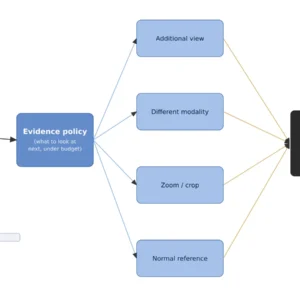
AOI Only Says “Defective” — How Vision Language Models Fill the Gap in Judgment Rationale
AOI systems report only pass or fail, never why. This article examines how vision-language models can supply the missing judgment rationale, turning an inspector's tacit expertise into structured, auditable evidence.
-
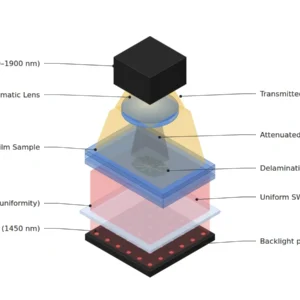
There Are Defects That Vanish in Visible Light — Inspection Design Beyond the 1 μm Barrier in SWIR Imaging
A defect with no contrast in visible light must be seen by changing the wavelength. This article maps how SWIR imaging works, how Cu-Cu bonded sensors opened up pixel pitch, and how lighting…
-
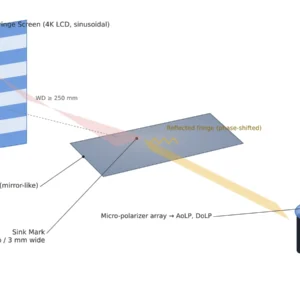
Catching 20 μm Sink Marks in High-Gloss Injection-Molded Parts with Phase Measuring Deflectometry (PMD) — The Last Gap Polarization Fusion Fills
A shallow depression on a specular surface creates almost no contrast under diffuse illumination. This article maps how PMD turns slope into the measurand, and how polarization fusion resolves the ambiguity a single…
-
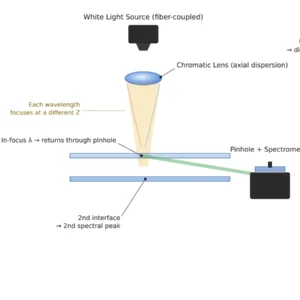
Where the μm Step Disappears: Measuring Both-Side Thickness Simultaneously with a Two-Channel Chromatic Confocal Controller
A 2 μm coating deviation is invisible to a 2D vision camera because neither color nor shape changes. This article covers how chromatic confocal converts axial displacement into a spectral signal, and how…
-
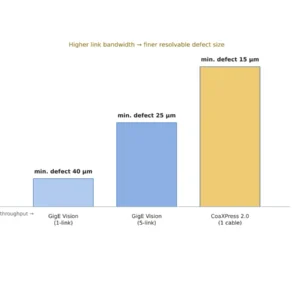
Camera Interface Bandwidth Determines Resolution — From GigE Vision to CoaXPress 2.0
Six 12MP cameras on a PCB inspection line hit a cable bottleneck before lens or lighting even matter. This article maps how GigE Vision versus CoaXPress 2.0, and edge AI on-device inference, trade…
-
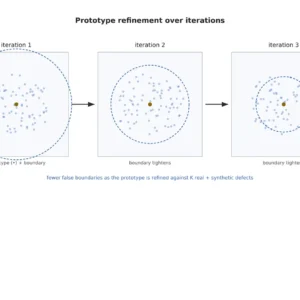
Few-Shot Anomaly Detection: Can 5 Defect Samples Stand Up an Inspection Line
A question repeats every time a new line is set up: how many defect samples before an inspection model can run? Few-shot anomaly detection uses mostly normal data plus 5-20 defect samples to…
-
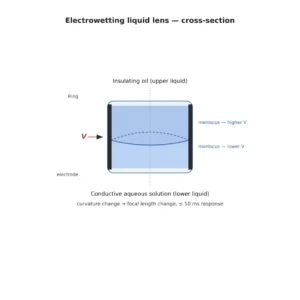
Liquid Lens Autofocus: Solving the Focus Problem on High-Mix, Low-Volume Production Lines
Focus subtly drifting every time a lot changes is a familiar problem on PCB and injection-molded part lines. Electrowetting liquid lenses cut refocus time to within tens of ms, but they are not…
-
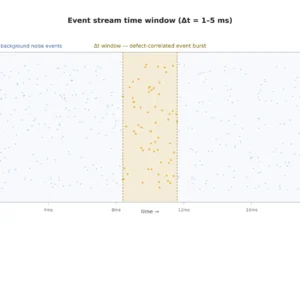
Ultra-High-Speed Micro-Defects Caught by Event Cameras (Neuromorphic Vision) — Seeing What Frames Miss
A wobbling connector pin, a flicking solder ball, a vibration-shifted alignment — these moments pass between frames on an ordinary camera. Event cameras (DVS) capture only brightness changes, at microsecond resolution.
-
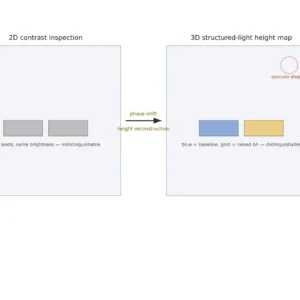
What 2D Contrast Can’t See: How 3D Structured-Light Inspection Measures Solder Joint Height
Two connector leads that look nearly identical in a 2D image can differ entirely in height. 3D structured-light inspection reconstructs actual surface shape instead of relying on contrast, but specular materials like solder…
-
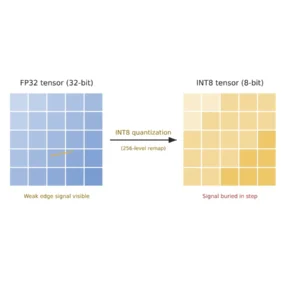
What You Must Check Before Applying INT8 Quantization to Edge AI Inference: Why Micro-Defects Quietly Disappear
A micro-scratch detection model quantized for edge inference looks fine on overall mAP, but a specific low-contrast defect class can quietly lose accuracy. Layer-wise quantization, edge hardware, and camera interface all interlock in…