
What Should a Camera See When a Humanoid Grasps an Object?
For a humanoid to manipulate an object, it has to adjust its motion in real time based on the object’s weight and posture. When that adjustment is inaccurate, the result is a failed grasp or a dropped object. In the end, accuracy comes down to the vision/edge-AI pipeline responsible for object recognition and pose estimation.
Whole-body control and object-manipulation research ultimately comes down to a fight over edge-inference speed and accuracy. Motion driven by language commands is only stable when the recognize → decide → control latency is short. Even ordinary manufacturing robot arms commonly see accuracy drop when pickup tasks switch from server inference to on-device (edge) inference — the FP32-to-INT8 quantization-loss problem. So whether humanoids reach commercial viability is likely to be decided less by robot hardware and more by the level of edge-inference optimization achieved.
That said, running cloud offloading (server inference) alongside edge inference secures accuracy, but communication latency becomes a new bottleneck — a practical compromise is on-device inference for motions that need real-time response (balance control), with server-assisted inference for motions that have relatively more slack (path planning).
Field Checkpoint: before adopting edge inference, first measure the actual accuracy drop after quantization using representative motion samples — performance cannot be confirmed before sample testing.
(This piece is a generalized edge-AI perspective written on the occasion of the news that Samsung established a physical-AI organization, and does not cover any specific company’s or robot’s specifications.)


You May Also Like
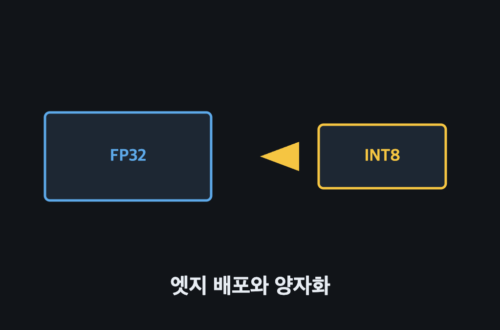
It Worked Fine on the Server — Why Does Accuracy Drop on the Edge?
In the Age of Deep-Learning Inspection, What to Check Before Camera Spec