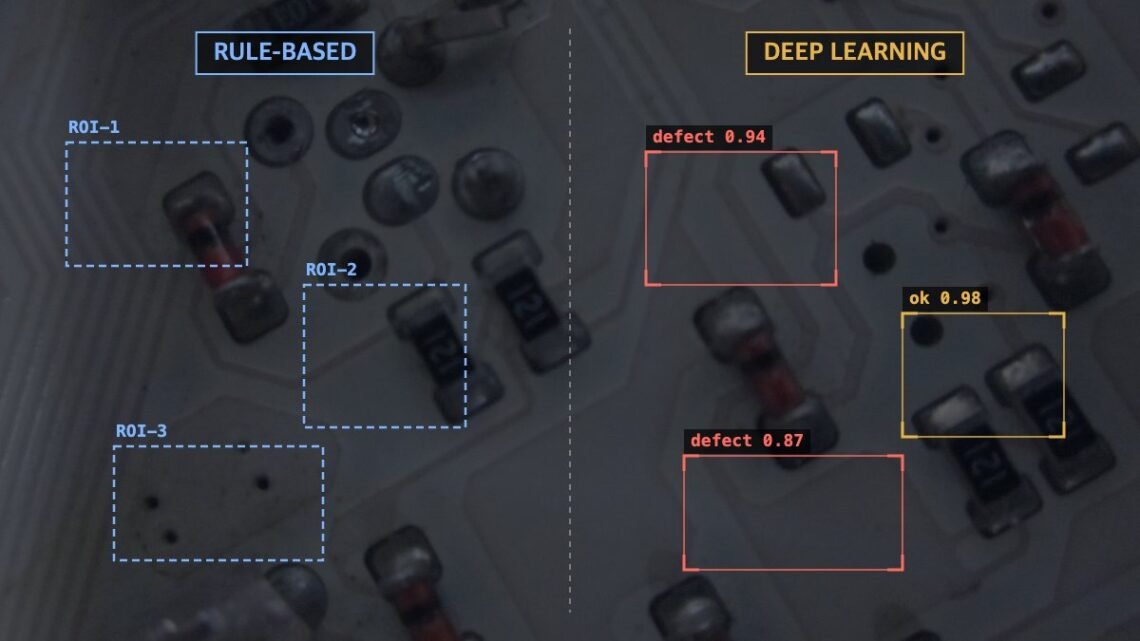
Deep Learning vs. Rule-Based Algorithms: When to Use Which
This question comes up often when building out a new vision-inspection setup: should you use deep learning, or is a traditional rule-based approach enough?
A rule-based algorithm judges good versus defective using rules a person defines directly — brightness threshold, area, length, position. Deep learning is where a model learns the judgment criteria on its own from good/defective image data. Neither is superior across the board; which one fits depends on the inspection conditions.
There’s a perception that deep learning is always better, but in the field that’s not the case. More often, work that a rule-based approach could have finished gets dragged into model training instead, and the only thing that grows is schedule and cost.
This piece compares the character of the two approaches and lays out the criteria for deciding which one to pick.
What Each Approach Is Like
Rule-Based — A Person Sets the Rules
A person directly specifies conditions like threshold, area, length, and position. Something like: if a region darker than this value is larger than this area, it’s defective.
Blob analysis, template matching, edge detection, and pattern matching all fall under this.
Deep Learning — The Rules Are Found From Data
Show the model good and defective images, and it builds its own criteria for telling them apart. There’s no need for a person to define the rule in words.
Classification, object detection, segmentation, and anomaly detection all fall under this.
Comparison
| Item | Rule-based | Deep learning |
|---|---|---|
| Development time | Short | Long, once data collection is included |
| Data required | Almost none | Hundreds to thousands of images |
| Compute load | Light | Needs a GPU or accelerator |
| Explainability of results | Possible — clear which condition was triggered | Difficult — hard to trace the basis for a judgment |
| Response to condition changes | Fragile — needs readjustment if lighting/position changes | Relatively robust |
| Fine-tuning | Immediate via parameter edits | Requires retraining |
| Adding a new defect type | Handled by adding a condition | Requires collecting data and retraining |
When Rule-Based Is Enough
If the conditions below apply, there’s no real reason to reach for deep learning.
1. The Inspection Target’s Position and Pose Are Fixed
If the part is held in a jig and always arrives in the same spot, the inspection region can be fixed. There’s no need to absorb positional variation, so rule-based has the advantage.
2. The Judgment Criteria Can Be Stated as Numbers
Judgments like “is the hole diameter above X millimeters,” “is the part present or not,” or “is the label attached” can all be expressed as rules.
Conversely, a judgment that can only be explained as “this looks a bit off” is hard to move into rule-based form.
3. Lighting and Background Can Be Controlled
The main cause of a rule-based system breaking down is condition change. If lighting is stable and the background is consistent, a rule-based system keeps running well for a long time.
4. The Basis for a Judgment Must Be Explainable
If you need to answer why a defect judgment was made, rule-based is the better choice. You can point to exactly which condition was triggered, immediately.
When Deep Learning Is Needed
1. The Shape of the Defect Is Different Every Time
A defect with inconsistent form — a scratch, a stain, foreign matter — is hard to define with rules. Add one condition, and another variant of the defect slips through.
2. The Range of “Normal” Is Wide
When the normal state itself is highly variable, as with manual-process products or natural materials, it’s hard to draw the boundary of “normal” with a rule.
3. A Person Can Tell, but a Rule Can’t
This is the case where an experienced person recognizes it instantly but can’t translate the criterion into words. This kind of tacit judgment is exactly where deep learning excels.
4. The Background or Conditions Change Frequently
In an environment where the product type changes often or lighting is hard to control, the maintenance burden of a rule-based system grows large.
The Practical Choice in the Field
Rather than treating this as a choice between the two, it’s better to split the roles between them.
| Stage | Method | Role |
|---|---|---|
| 1. Position alignment | Rule-based | Correct target position/rotation |
| 2. Region extraction | Rule-based | Crop out the inspection region |
| 3. Judgment | Depends on the situation | Rules for well-formed defects, deep learning for irregular ones |
| 4. Dimensional measurement | Rule-based | A rule-based calculation is accurate for numeric values |
It’s common to see attempts to push even position alignment and dimensional measurement onto deep learning. Rule-based is usually faster and more accurate for those. The efficient approach is to reserve deep learning for exactly the part rules can’t handle.
A Decision Sequence
When reviewing a new inspection, checking these in order makes the decision easier.
- Can the inspection criteria be written as numbers? → If yes, rule-based
- Can you gather hundreds of defect samples? → If that’s hard, rule-based or anomaly detection
- Can lighting and position be fixed? → If yes, rule-based has the advantage
- Does the judgment need to be explainable? → If needed, rule-based
- If none of the above apply → consider deep learning
Closing
Not using deep learning doesn’t make a system outdated. Design means picking the method that fits the problem.
Conversely, if you’ve been stuck on rule-based for months and every added condition breaks something else, that’s the signal to switch approach.
Frequently Asked Questions
Q. What techniques fall under rule-based algorithms?
Classic image-processing techniques where a person specifies conditions numerically — blob analysis, template matching, edge detection, and pattern matching — fall under this.
Q. How much data is needed to use deep learning?
Generally, hundreds to thousands of good and defective images are needed. If gathering defect samples is difficult, anomaly detection trained only on normal data is an alternative.
Q. When is the right time to switch from rule-based to deep learning?
The signal to switch is when adding conditions keeps breaking judgments elsewhere, and the defect’s shape is different every time such that it can’t be defined by a rule.
The content of this article represents general decision criteria. Actual application can vary depending on the target and the environment.
Related Reading — Overdetection vs. Missed Detection — Which One Costs More?


You May Also Like
Few-Shot Anomaly Detection: Can 5 Defect Samples Stand Up an Inspection Line
Shape Defects 2D Can’t Catch: When 3D+AI Inspection Is the Answer