Ultra-High-Speed Micro-Defects Caught by Event Cameras (Neuromorphic Vision) — Seeing What Frames Miss
A wobbling connector pin on a high-speed assembly line, a solder ball flicking momentarily, an alignment shifting minutely from vibration — these moments pass by while an ordinary frame-based camera’s shutter is closed. No matter how high the frame rate goes, it is ultimately still just a sequence of discrete snapshots, so whatever happens between two frames is fundamentally never recorded. Leaving this blind spot unaddressed lets micro-cracks or momentary vibration anomalies pass straight through the inspection line, surfacing as defects only downstream — or even after shipment. Trying to force this gap shut with a several-thousand-fps high-speed camera causes data volume and illumination power requirements to grow exponentially, and cost-effectiveness drops off sharply.
The physical solution to this problem is the event camera, also known as the neuromorphic vision sensor (DVS). Because it outputs a signal asynchronously, on a per-pixel basis, only at the instant a brightness change occurs, a static background generates no data at all, and only points where change occurs are captured with microsecond (µs)-scale time resolution. Since the event-generation pattern varies substantially with the inspection target’s surface material and reflectivity, the first step before adoption is confirming whether the target is a glossy metal surface or matte plastic.
Why event cameras are favorable for micro-defect inspection
Point. Event cameras are a viable alternative to conventional frame cameras for detecting vibration-related or momentary defects that demand ultra-high speed and high dynamic range.
Reason. According to research on computational neuromorphic imaging, event-based sensors can achieve a sampling time span up to 300x wider and dynamic range exceeding 10,000x in high-speed motion. This means data doesn’t drop out even when lighting conditions change abruptly or the target momentarily vibrates or rotates. Because each pixel responds independently rather than integrating light over an exposure period as a frame camera does, motion blur structurally cannot occur.
Example. A study applying neuromorphic vision to countersink inspection on aircraft fasteners reported roughly a 10x inspection speedup and precision on the order of 0.025mm compared to conventional methods. A separate remote vibration-measurement experiment also confirmed a case where an event camera tracked minute displacement patterns down to sub-pixel level, at accuracy comparable to a laser Doppler vibrometer (LDV). However, these figures are specific to the experimental conditions of those papers, and it cannot be confirmed that they reproduce as-is under different inspection-target surface materials or lighting environments — verification through sample testing is required.
Point. Ultimately, the strength of an event camera lies not in “how fast” but in the data efficiency of “recording, without waste, only the instant change occurs” — and this is especially effective for inspection items like vibration or impact defects, where the moment of occurrence cannot be predicted.
On a heavily specular metal surface, even minute light-source flicker can be falsely detected as an event, so lighting stability and diffuse-reflection-suppression design are a precondition for adopting an event camera. This is addressed concretely in the optical-setup table below.
Core framework matching table
| Item | Spec |
|---|---|
| ① Minimum detectable defect size | 25µm (converted from a 0.025mm countersink-precision baseline; final value requires re-confirmation via sample testing) |
| ② Optical setup | Event camera (DVS, VGA–HD-class resolution) + low-noise constant-current LED coaxial epi-illumination (flicker suppression essential) + telecentric or low-distortion lens, WD 50–150mm secured (including clearance margin for target vibration) |
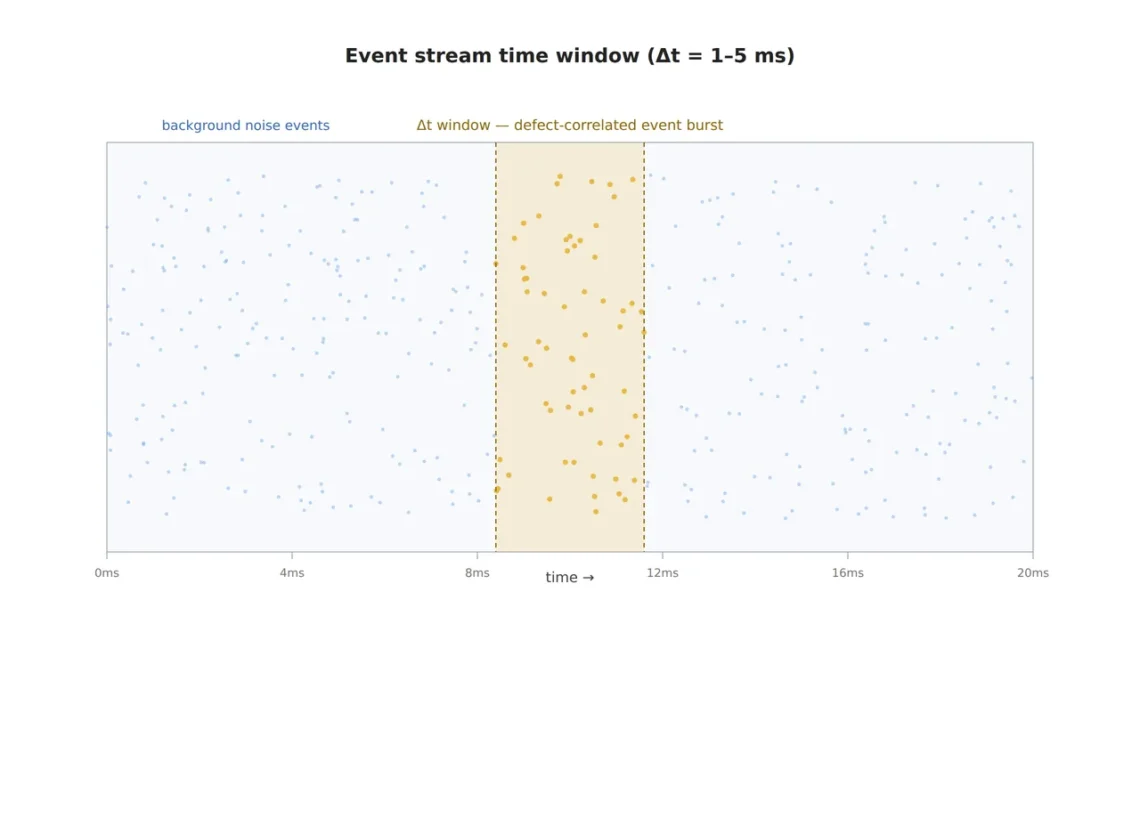
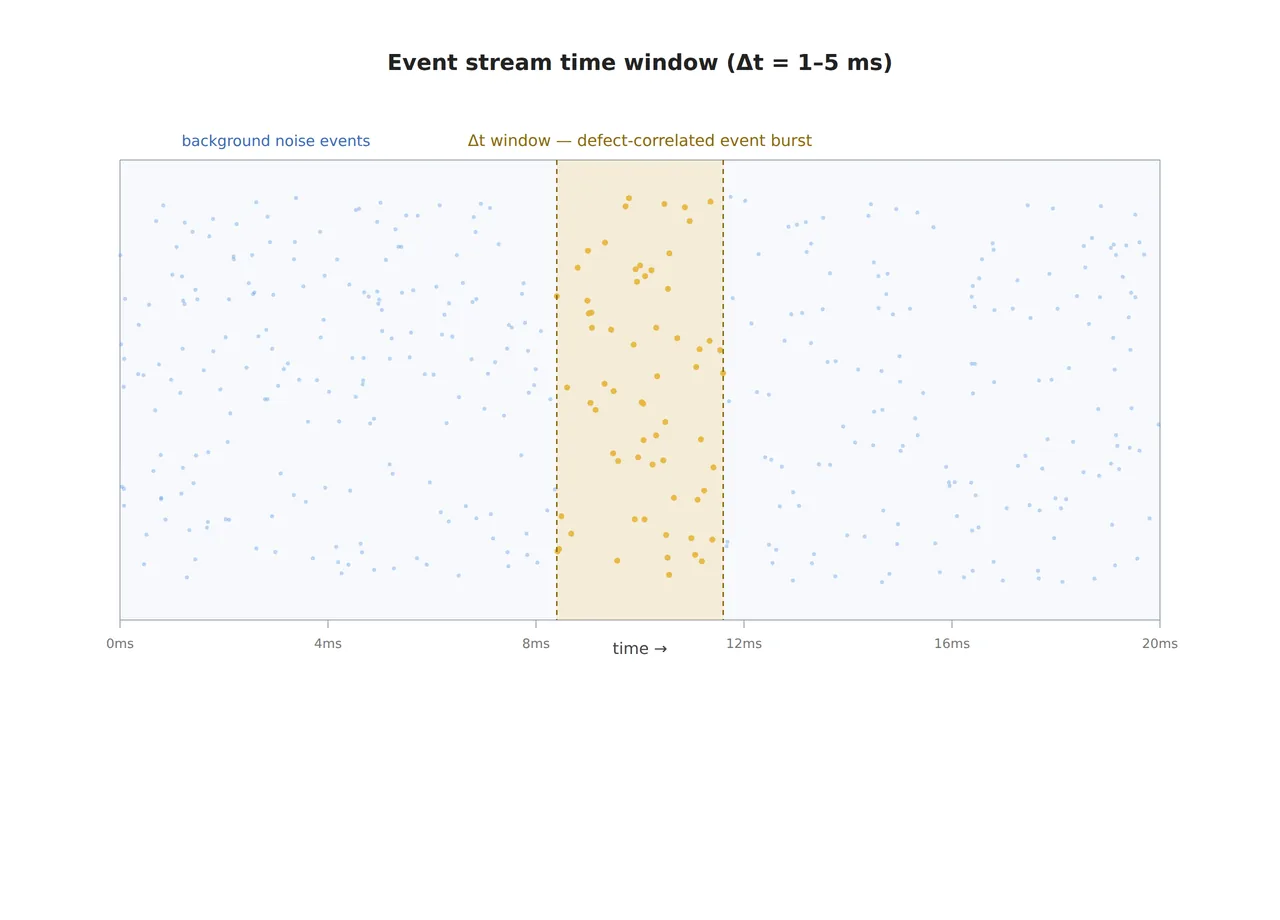
| ③ Algorithm parameters | Event-stream time window 1–5ms, noise-filtering threshold event rate setting, matching based on scale/rotation-invariant feature descriptors |
Takeaway: as the table shows, the key to adopting an event camera lies less in the camera itself than in the lighting’s temporal stability and securing lens WD margin. If lighting flickers even minutely, it can be mistaken for event noise, causing both missed and false detections — so adopting constant-current-driven lighting is effectively a mandatory requirement.
A comparative note — when a frame camera is still favorable
For inspection that needs “one complete image at a single instant” — such as precision dimensional measurement of a stationary target, or color/texture discrimination — a high-resolution frame camera is still favorable. Because an event camera generates no data for regions with no change, it is actually information-poor for a static, full-appearance inspection. Which approach wins out depends on the inspection target’s dynamic characteristics and surface reflectivity, so before actual line deployment, sample testing is required to narrow down what cannot be confirmed.
Field Checkpoints
- WD (working distance) secured: given the target’s vibration/rotation characteristics, has it been confirmed that a safety margin of at least 50mm WD is maintained between camera, lens, and target?
- Has the lighting’s temporal stability (flicker or not) been verified at the level of event noise?
- Has the target surface’s reflectivity profile been measured in advance to rule out false detection from specular reflection?
- Has the event-stream time-window setting been tuned to match the actual line speed (vibration frequency)?
References
- Ultrafast Dynamic Defect Inspection With Computational Neuromorphic Imaging (PMC)
- High Speed Neuromorphic Vision-Based Inspection of Countersinks in Automated Manufacturing Processes (arXiv:2304.04108)
- Anomaly Detection Through Remote Vibration Measurement Using Neuromorphic Event-Based Camera (Springer)
Related Patents (assignee confirmed)
- US 11,856,290 — Prophesee, “Method and apparatus of processing a signal from an event-based sensor”
- US 11,825,218 — Sony Advanced Visual Sensing AG, “Dynamic region of interest (ROI) for event-based vision sensors”
- US 9,934,557 — Samsung Electronics Co., Ltd., “Method and apparatus of image representation and processing for dynamic vision sensor”


You May Also Like
The Line-Scan Camera You Picked by Line Rate Alone — Why It Still Misses Defects: TDI and the Resolution Design Relationship
Catching 20 μm Sink Marks in High-Gloss Injection-Molded Parts with Phase Measuring Deflectometry (PMD) — The Last Gap Polarization Fusion Fills