Why Fewer False Alarms Matter More Than Faster Detection in Edge Fire-Detection AI
EDGE AI
Of the two numbers, the one that moves the site is the 80% cut in false alarms, and making people trust those alarms falls to camera placement and the confirmation procedure.
I turned the two figures of an underground-garage EV fire detection model announced on September 1, 2026 into the size of one camera pixel and a count of alarms.
About 11 min read
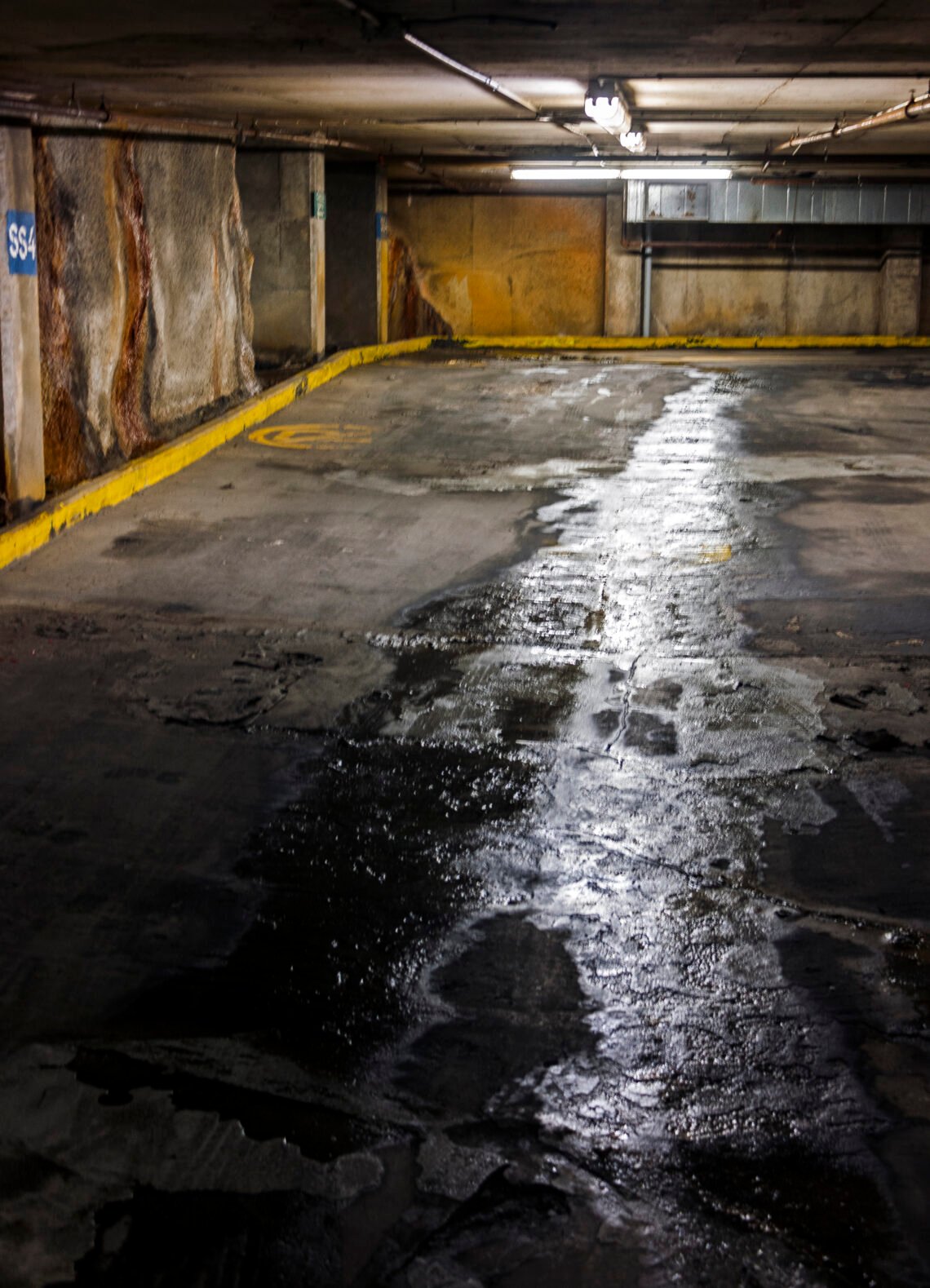
Start with the surfaces an underground-garage camera sees. Where the floor is painted smooth, ceiling lights and headlights leave glossy hotspots like a mirror, and car paint and glass bounce the same light once more. The thing to find is thin smoke rising between them. Half transparent with blurred edges, smoke has low contrast1, so it is hard to pick out in the same frame as those glossy hotspots.
A system that keeps raising false alarms makes the staff switch the alarm off or ignore it, and from that moment no detection speed is of any use. If the first few minutes of a real fire are missed, the fire can spread between parked cars, and the damage may not stay with one car.
On September 1, 2026, Superb AI announced that it had developed an early-detection AI model for EV fires in underground garages together with Korea's National Fire Research Institute. Compared with existing fire detection methods, it cut detection time by 65% and lowered the false alarm rate by 80%, running in real time on edge devices2 on site without going through the cloud. To put these two numbers in the site's language, read the comparison basis first, then recalculate them as a count of alarms and the size of one camera pixel.
What the two numbers are compared against
The comparison basis in the report is existing fire detection methods. Which detectors and which settings served as the reference, and absolute values such as how many minutes detection went from and to, are not in the article. So 65% and 80% can only be read as ratios, and they are numbers whose baseline3 should be obtained in writing before moving them to another site.
The conditions the article does give are these. About 100,000 images containing fire, smoke and vehicles were processed into training data, combining real accident material with controlled experimental material, with rare scenes filled in by generative AI synthetic data. The data is said to cover thin smoke under vehicles, smoke at a distance, low light4 and dense parking. After a field demonstration in an underground garage in November 2025, smoke detection performance was confirmed in August 2026 with an experiment reproducing a real fire, and the hardware is Jetson-based edge equipment.
The conditions I mark in this list are smoke at a distance and low light. Both scenes turn directly into the area one camera pixel covers and the amount of light, so they can be carried to a site by calculation. The image count and the synthetic ratio belong to the model side, so those numbers alone say little about performance at a particular site.
Even with false alarms down 80%, most alarms are still false
Start by counting alarms. Assume an underground garage with 40 cameras and put the false alarms one camera raises per day under the existing method at 0.1. That makes 4 a day and 1,460 a year. Lower the false alarm rate by 80% and it drops to 0.8 a day, 292 a year. A control room whose phone rang four times a day goes quiet to about four times in five days, and that number sets how the change feels on site.
Real fires are far rarer. Assuming this garage has a fire once in ten years, the yearly expectation is 0.1, and the share of alarms that are real fires is 0.0068% under the existing method and still 0.034% after the 80% cut. It means the false alarms trailing each real fire fall from 14,600 to 2,920. The drop is large, but when an alarm sounds, the chance that it is a fire is still very small.
292per year
False alarms in a year after the 80% cut (40 cameras, 0.1 per camera per day assumed)
0.034%
Share of alarms that are real fires (one fire in ten years assumed)
2,920alarms
False alarms trailing one real fire
So a confirmation procedure has to stand outside the detection model. When an alarm sounds, the previous seconds of that camera's video come up on the operator's screen at once, and a person makes the call within seconds. The article says detection triggers on-screen warnings and an alarm sound and keeps a detection history, connects with existing safety and building management systems, and offers a dashboard that shows several sites on one screen. I would note, next to detection time, how many seconds it takes on that screen to confirm one alarm.
Smoke 15 m away covers 18 pixels on screen
Turn the article's smoke at a distance into numbers. Assume a camera with a 1,920 px wide sensor of 2.9 μm pixels and a 4 mm lens: the sensor is 5.57 mm wide, and the field of view5 at 15 m is 20.9 m across. The width one pixel covers at that distance is 10.9 mm, or 10,880 μm. Assuming a smoke column 200 mm wide, it covers 18.4 pixels.
With the same camera, smoke 30 m away sees each pixel grow to 21.8 mm and shrinks to 9.2 pixels. Doubling the distance halves the pixels the smoke covers, and its area falls to a quarter. Thin smoke has blurred edges, so as the pixel count drops, more of it mixes with the background, which leads me to expect the model to see the same smoke less surely at 30 m. How right that expectation is can only be checked with test video at each distance.
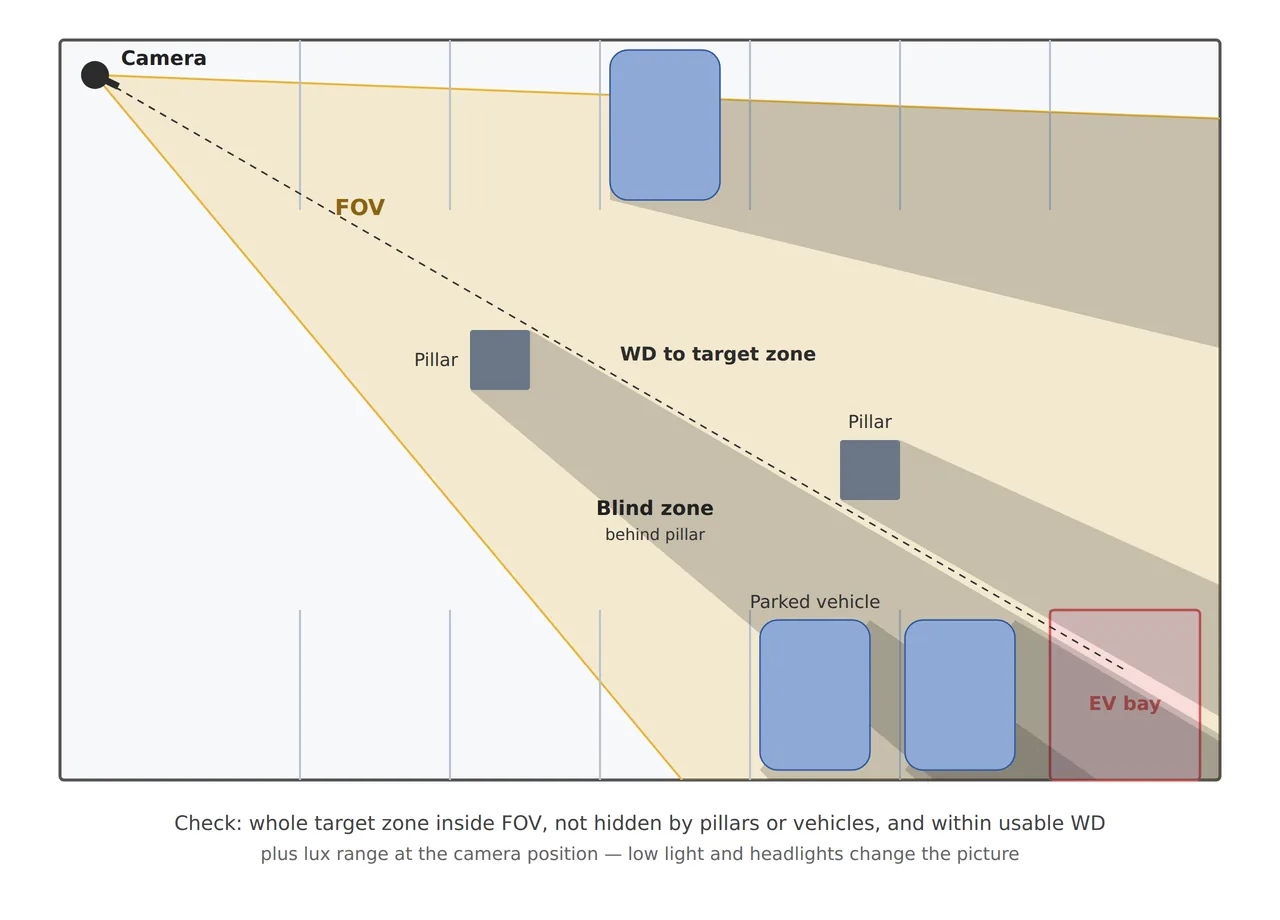
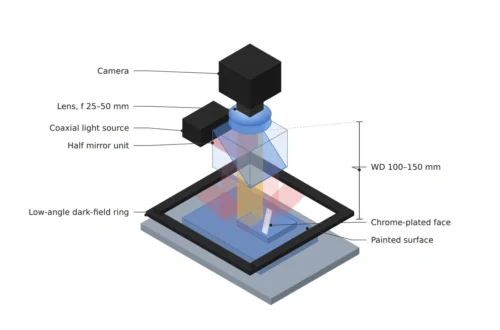
What to look at in the figure is the gray shadow inside the fan-shaped field of view. If the blind zones made by pillars and parked cars cover the charging bay, smoke in that bay never enters the frame, whatever the model's performance. The longer the distance from camera to target zone, that is the WD6, the smaller the smoke becomes and the more cars come between. I would first draw a layout where two cameras see each charging bay from different directions.
The amount of light goes into the same calculation. In dark stretches you must lengthen the exposure or raise the gain; a long exposure smears the edge of rising smoke, and higher gain makes noise blotches that look like smoke. When headlights pass, part of the frame blows out white instead. Only after measuring the illuminance7 range at each camera position in lx, by day, by night and at the hours cars come and go, can the scenes the model learned be held against the scenes on site.
Count the time a person spends on each alarm
Work through the 65% cut in detection time the same way. Assuming the existing method takes 10 minutes to notice smoke, the new model takes 3.5 minutes, 6.5 minutes earlier. For those 6.5 minutes to stay alive on site, confirmation and response after the alarm have to finish within them. If confirming one alarm takes a minute, 5.5 of the minutes gained remain.
The persistence condition8 is the knob that trades the two numbers. If a camera watching 15 frames per second raises an alarm only when smoke persists for 2 seconds, 30 frames in a row are checked, so false alarms drop and detection comes at least 2 seconds later. The article gives neither the decision threshold nor the persistence condition, so they are items to get from the vendor. Detection time and false alarm rate move together on the same settings, so the first thing I ask is whether the two numbers come from the same settings. The table below lines up three rows, from smoke size to alarm conditions.
| Item | Value | Condition and basis | In plain words |
|---|---|---|---|
| ① Minimum defect size | Smoke 200 mm wide (assumed) = 18.4 px at 15 m, 9.2 px at 30 m | One pixel 10,880 μm (15 m), 21,750 μm (30 m). Assumed 1,920 px sensor with 2.9 μm pixels and a 4 mm lens | The farther away, the more pixels the smoke loses on screen |
| ② Optical setup · WD | Two cameras from two directions per charging bay, WD to the target zone within 15 m (assumed) | Check occlusion by pillars and vehicles, headlight reflections, and the illuminance (lx) range at the camera position by time of day | Watch from two places that nothing hides |
| ③ Algorithm parameters | Persistence condition (2 s at 15 fps = 30 frames, assumed), decision threshold, 1-minute confirmation (assumed) | Even after the 80% cut, with 40 cameras and one fire in ten years assumed, 99.97% of alarms are false | When it sounds, a person looks at the video right away and decides |
Of the three rows, the one that sets site performance is ②. Smoke inside a blind zone is never caught however ③ is tuned, and the pixel count in ① is set by the WD in ②. Row ③ is the knob on top that trades false alarms against detection time, and where the knob sits has to be decided together with the speed of confirmation. On a site whose floor coating shines, how often headlight reflections read as smoke changes, so whether the 80% holds at that site cannot be guaranteed before a sample test.
Tying boards scattered over dozens of sites to one model
News from the deployment side came out the same day. DEEPX announced that it had connected its NPU9 to AWS IoT infrastructure, building a system that ties together AI model conversion and the deployment and management of NPU runtime environments on field devices. Introduced on the AWS technical blog on August 27, the setup links the DX-M1 NPU with AWS IoT Core and AWS IoT Greengrass and pushes runtime environments, drivers and firmware down by device group. When boards are scattered over dozens of garages, as with fire detection, installing the same version everywhere after fixing a model and knowing which board runs which version sets operating cost as much as the false alarm rate does. If the new model with fewer false alarms is installed at only half the sites, the false alarms the control room feels are the average of two versions. I would ask that every alarm record carry the model version at that moment.
Turning detection figures into the numbers of camera placement and alarm operation is the work of the engineer who designs video fire detection, and someone who can do this calculation translates a vendor's numbers into a site's numbers. Seen from the budget, the number of cameras and their placement, confirmation staff and version management weigh on total cost along with the model's performance figures. This article explains technology and is not investment advice. See our Disclaimer.
Field Note
If this model came to an underground garage, for the first two weeks I would run it in a record-only mode that does not send alarms to the control room, collecting false alarms per camera along with the video of each moment. If false alarms cluster on one camera, I look first at headlight reflections and floor gloss at that spot. Then I put a second camera at the charging bay with the largest blind zone and count the same two weeks once more.
Field Checkpoints
Once the two weeks of records are in hand, hold the vendor documents and the site numbers against each other with the questions below.
- Did you get the comparison basis for detection time and false alarm rate (which existing method, which settings) in writing? (65% and 80% are only ratios)
- Did you calculate the WD to each charging bay and the pixels the smoke covers? (18 pixels at 15 m, 9 at 30 m)
- Did you draw the blind zones made by pillars and parked cars on the layout? (no model sees hidden smoke)
- Did you measure the illuminance (lx) range at each camera position by time of day and check the frame as headlights pass? (whether blown-out spots get read as smoke)
- Do detection time and false alarm rate come from the same threshold and the same persistence condition? (the two numbers move together on one knob)
- Did you time how long a person takes to confirm one alarm? (time taken out of the 6.5 minutes gained)
- Does each alarm record carry the model version installed at that site? (mixed versions mean a mixed false alarm rate)
Frequently Asked Questions
Does adding a thermal camera cut false alarms?
The input the article describes is CCTV video. A thermal camera sees temperature change through the infrared radiation coming off surfaces, so it adds a different signal from a video camera, but how far false alarms would fall with the two signals combined is not in the article. It is hard to say before running both setups side by side at the same site.
Does a higher-resolution camera catch distant smoke?
With the same lens and a 3,840 px wide sensor (assuming the same sensor width), each pixel is halved, so smoke at 30 m also covers 18 pixels. In exchange, smaller pixels on a sensor of the same size each receive less light, raising noise in dark stretches, and the image is four times larger, raising the compute load on the board. It is better to choose by comparison with changing the lens to narrow the field of view.
Glossary
- [1] Contrast contrast
The brightness difference between a target and its background. Thin smoke is close to the background in brightness, so its contrast is low. ↩ - [2] Edge device edge device
A device that runs inference right next to the camera without sending video to a server. ↩ - [3] Baseline baseline
The existing method and conditions a performance comparison starts from. With a different baseline, the same 65% means something else. ↩ - [4] Low light low light
Shooting conditions short of light. Exposure must be lengthened or gain raised, so smearing and noise increase. ↩ - [5] Field of view FOV, field of view
The area one camera frame takes in. It widens with distance, and so does the width one pixel covers. ↩ - [6] WD working distance
The distance from the front of the lens to the target. In a garage it is the distance from camera to target zone. ↩ - [7] Illuminance illuminance
The amount of light reaching a surface, measured in lx. With the same camera, lower illuminance makes the image darker and grainier. ↩ - [8] Persistence condition persistence condition
A rule that raises an alarm only when smoke continues across several frames. It keeps a passing reflection from setting it off, at the cost of detecting that much later. ↩ - [9] NPU neural processing unit
A chip dedicated to neural network computation. ↩
References
- News1, Superb AI develops detection AI model for underground-garage EV fires (in Korean), September 1, 2026 (65% shorter detection time and 80% lower false alarm rate versus existing fire detection methods, Jetson-based edge equipment, about 100,000 images, field demonstration in November 2025 and reproduction experiment in August 2026)
- News1, DEEPX and AWS build a cloud-edge operating system for physical AI deployment (in Korean), September 1, 2026 (DX-M1 NPU, AWS IoT Core and Greengrass, deployment by device group)
- Formulas: one pixel = sensor width × distance ÷ focal length ÷ horizontal pixel count, yearly false alarms = cameras × daily false alarms per camera × 365, share of alarms that are fires = yearly fires ÷ (yearly false alarms + yearly fires)
Related reading — Edge AI Inference Latency Is Set by the Camera Interface Before the NPU · What Should a Camera See When a Humanoid Grasps an Object? · Why Edge AI Vision Fails on the Factory Floor

Noctvision
An engineer who has handled mechanical design and project management for production equipment since 2005. Here I work through the cameras, lenses and lighting that go into equipment with formulas and public data, and record the assumptions and sources alongside the numbers.


You May Also Like
Why Edge AI Vision Fails on the Factory Floor
In Automotive Part Appearance Inspection, Lighting Design Comes First