-
Building a Vision Inspection App with PySide6 and OpenCV
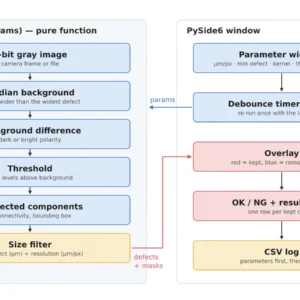
In a 220-line PySide6 and OpenCV inspection UI, a 3 px size filter and a 25-level threshold set the detection floor together. Without bytesPerLine a 1,021 px wide image turns a 265 px…
-
What to Write First in a Spec Sheet Before Buying Machine Vision Equipment
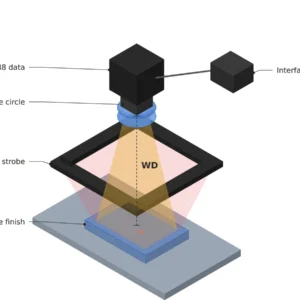
For a 100 μm defect on a 100 mm cover moving at 100 mm/s, filling the request in the order 33.3 μm/px, 244 μs and 122.9 MB/s brings comparable quotes. A 1% miss…
-
Reserve Room for Vision Cameras and Lighting at the Mechanical Design Stage
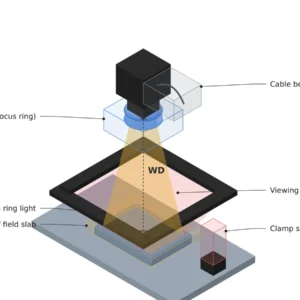
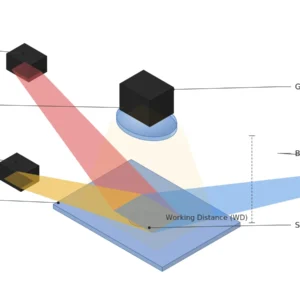
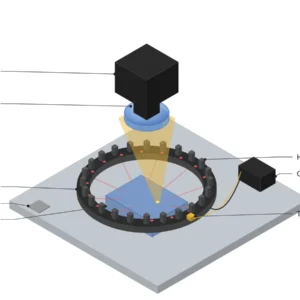
After mechanical design is done, there is no room for the light. A ring light for a 100 mm FOV needs a 106.5 mm opening at 30 mm, and a 40 mm low-angle…
-
Why Edge AI Vision Fails on the Factory Floor
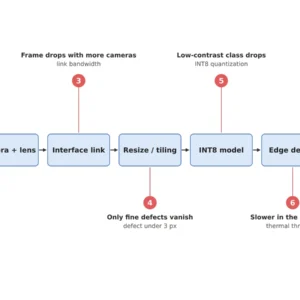
Shrink a 20 MP image to a 640 px input and a 60 μm scratch becomes 0.35 pixel. Before retraining a wobbling edge AI inspection, I worked out the one number to measure…
-
The Vision Decision Is Done, So Why Does the PLC Learn It Late?
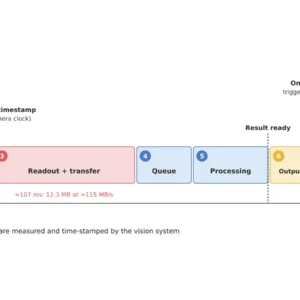
Even with inference done in 25 ms, a 4,096 × 3,000 px image takes 106.9 ms just to cross 1GigE. With a 60 ms processing p99, over 1% of results land after the…
-
For Scratches on Highly Reflective Metal, Choose the Lighting First
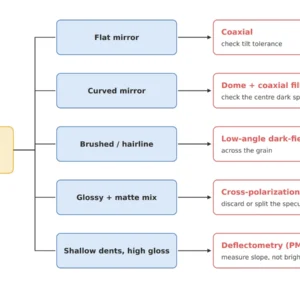
Scratch lighting on polished or plated metal is chosen by surface shape: coaxial for flat mirrors with a 0.93° tolerance without a diffuser, a dome for curves, 15° low-angle light for hairlines, and…
-
Changing the Sensor Means Recalculating the Illumination
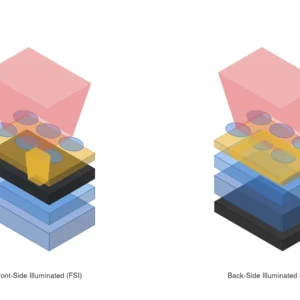
A quantum efficiency of 15 % at 940 nm demands 4.9 times the photons and 2.85 times the watts of lighting compared with 550 nm, rising to 14.6 and 8.5 when the exposure…
-
On Moving Parts, Photometric Stereo Shrinks the Standstill Condition to 0.5 ms
On a moving part, photometric stereo moves its standstill condition into the gap between two exposures. At 50 μm/px and 100 mm per second the gap is 0.5 ms, and directions split by…
-
When an LED Light Dims, Yesterday’s Threshold Misses Today’s Defect
If a white particle clears its threshold by 14.3 %, it passes without any alarm once light output falls 15 %. Warm-up alone can take 7.5 %, so the stop limit sits at…
-
Flat-Field Correction Gain Amplifies Noise Along with Uneven Light
Flat-field correction restores only the average brightness of the corners. A 1.67 gain on a corner getting 60 % of the light raises noise 1.29 times and the chance of crossing the same…