-
Edge AI Inference Latency Is Set by the Camera Interface Before the NPU
An NPU twice as fast cuts decision latency only from 21.2 ms to 17.2 ms, because the 10.7 ms a 12 MP frame spends crossing 10GigE is half the total. What RDMA, link…
-
Why a Line-Scan Camera Chosen by Line Rate Alone Misses Defects
Line rate is speed divided by pixel size: 40 kHz at 400 mm/s and 10 μm. 64 TDI stages stretch exposure to 1.6 ms but smear 0.64 pixel at a 1 % speed…
-
Can One Focus Plane Keep Parts of Every Height Sharp?
One frame covering a 0.5 mm pin-height spread needs f/16, where the diffraction MTF for a 20 μm crack falls to 0.24. Two frames at f/8 or three at f/5.6 keep 0.60 to…
-
On Reflective Surfaces, a Bilateral Filter Keeps the Crack a Gaussian Blurs Away
At 10 μm/px a 3×3 median keeps nearly all the contrast of a 40 μm particle, but a 5×5 leaves only 12.8 to 23.2 GV. A 15 μm crack keeps 8.3 GV after…
-
Why a PCB Micro-Crack Revealed by Multi-Angle Lighting Vanishes in a Downscaled AI Input
A 30 μm crack on three pixels needs a 4,096 px image, and a 960 px model input shrinks it to 0.70 pixels. With 20 native tiles and a 100 ms budget, fusing…
-
In PCB Inspection, the Lens Comes Before the AI
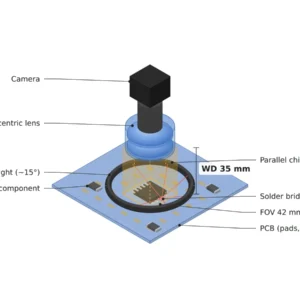
A conventional lens viewing a 42 mm field from 150 mm looks 8.0° off vertical at the edge, hiding 0.28 mm beside a 2 mm tall part. A 25 μm bridge in that…
-
In the Age of 8K Line-Scan Cameras, the Lens Still Sets the Ceiling on Inspection Resolution
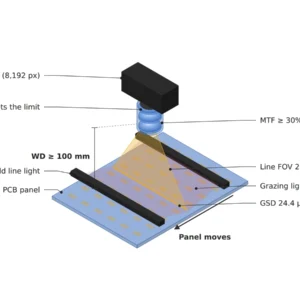
At a 200 mm view, 8K puts a 50 μm bridge on 2.05 pixels and the lens needs an MTF of 0.33 at 34.9 lp/mm. At f/8, which covers 1.5 mm of warp,…
-
In 2D/3D Fusion Inspection, the Bottleneck Is Lighting Interference
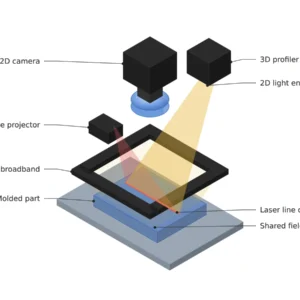
When 2D lighting and a 3D laser share a band they must take turns, and a 3 ms gap at 200 mm/s leaves a 600 μm offset. Correcting it at nominal speed holds…
-
The Defect Zone You Miss When You Switch to 3D Inspection
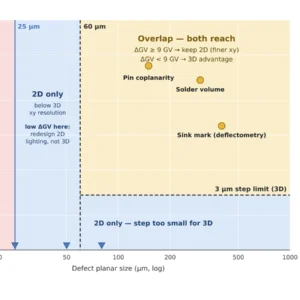
A 2D line-scan at 8.33 μm/px has a 25 μm planar floor; a 3D profiler at 20 μm/px xy has 60 μm. Defects in between shrink to 1.3 to 2.75 pixels in 3D,…
-
The Price of KLA’s Patent That Puts Detection and Classification in One Network
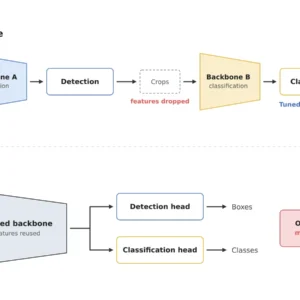
When detection and classification share a backbone, 50 candidates per frame drop from 240 ms to 55 ms, but a retrain that adds a new type shakes detection recall too. Telling a 5-point…