-
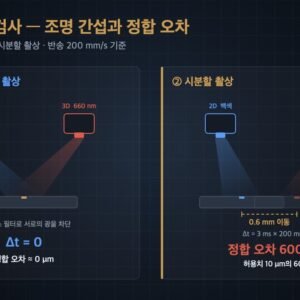
2D/3D Fusion Inspection: The Bottleneck Is Lighting Interference
When a 2D camera and 3D profiler share the same wavelength band, no camera spec fixes it. Wavelength separation, not time-division capture, is usually the answer — and here is the math on…
-
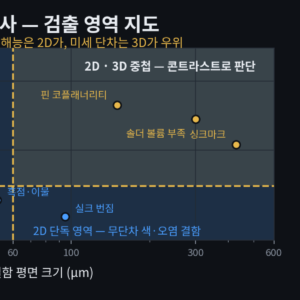
The Defect Zone You Miss When You Switch to 3D Inspection
A 3D profiler's planar (xy) resolution is coarser than 2D line-scan. See how to route defects between 2D and 3D by measured contrast, not size, with WD and optical-setup specs.
-
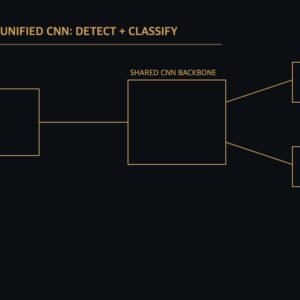
Detection and Classification in One Model — The Trade-offs of KLA’s Unified CNN Patent
A look at KLA's unified-CNN patent (US10607119B2) for simultaneous defect detection and classification, and the tuning trade-off it creates versus separated pipelines.
-
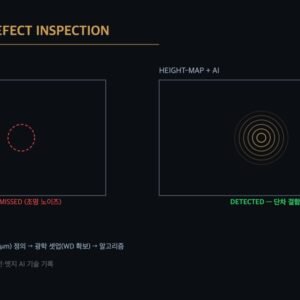
Shape Defects 2D Can’t Catch: When 3D+AI Inspection Is the Answer
SICK's Nova combines deep learning with 3D height-map data to catch shape defects 2D inspection misses, with on-device retraining from a handful of samples.
-
What Should a Camera See When a Humanoid Grasps an Object?
Humanoid grasping accuracy hinges on the vision/edge-AI pipeline -- a look at the on-device vs. cloud-offload trade-off and the INT8 quantization-loss problem.
-
What Changes in Vision Inspection When Logistics Automation Moves Into the Front End
As front-end semiconductor logistics automation expands, vision-based position checkpoints at transport handoffs become the standard defense against alignment drift.
-
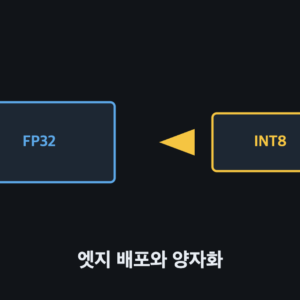
It Worked Fine on the Server — Why Does Accuracy Drop on the Edge?
Accuracy that holds up on a server often drops on edge hardware -- usually the quantization step (FP32 to INT8), not the model, is the real cause.
-
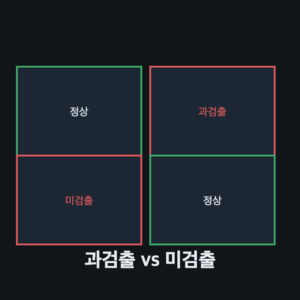
Overdetection vs. Missed Detection — Which One Costs More?
Overdetection and missed detection can't both be driven to zero -- a look at how threshold cost asymmetry, and KLA's nuisance-filtering patent, shape the trade-off.
-
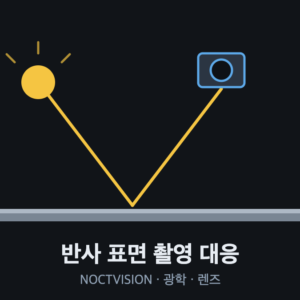
How to Handle Imaging on Highly Reflective Surfaces
Five practical ways to handle blown-out highlights on specular surfaces -- angle changes, coaxial and dome lighting, polarization, and multi-shot compositing -- with the trade-offs of each.
-
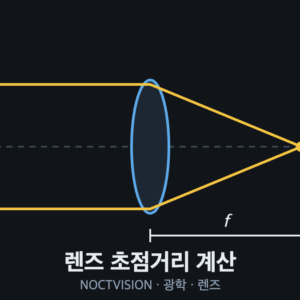
How to Calculate Machine-Vision Lens Focal Length
A step-by-step method for calculating machine-vision lens focal length from working distance, field of view, and sensor size, plus the resolution check that follows it.