-
The Error Frame Temperature Leaves in Two-Sided Chromatic Confocal Thickness Measurement
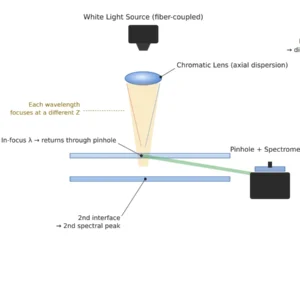
A 1 K change in the steel frame between two heads moves the thickness reading by 1.17 μm. How two-channel, two-sided chromatic confocal measurement removes the refractive index, and how heat, tilt and…
-
Camera Interface Bandwidth Determines Resolution
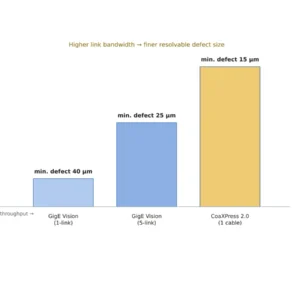
Running a 12 MP 8-bit camera at 60 fps takes 737 MB/s, not 2.2 GB/s. From 1GigE to CoaXPress 2.0, this works out the pixel size each link allows, what happens to a…
-
Can Five Defect Samples Stand Up a Few-Shot Anomaly Detection Line?
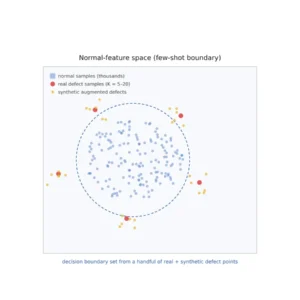
Catch all five defects and the 95 % lower bound on recall is still 55 %; claiming 95 % takes 59. What few-shot anomaly detection can set up, what it cannot prove, and…
-
How Liquid Lens Autofocus Solves Focus on High-Mix, Low-Volume Lines
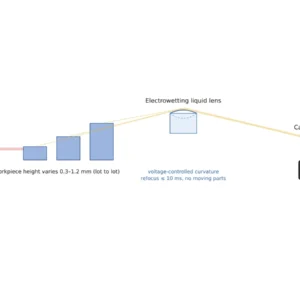
On a line mixing chip heights from 0.3 to 1.2 mm, a liquid lens needs less than 0.1 D of change. Worked out here: the resolution fixed focus loses, ±0.023 D repeatability, a…
-
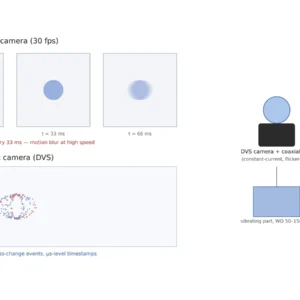
Catching the Moment Frames Miss with an Event Camera
A 200 fps camera misses 70 % of 0.5 ms events. Using a bouncing solder ball, this works out how fast an event camera pixel can follow, when PWM lighting overflows the sensor…
-
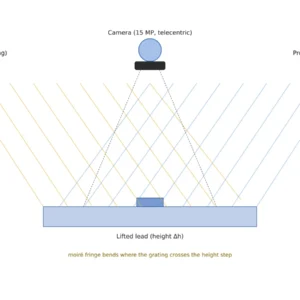
How 3D Structured Light Measures a Solder Lead Lift That Brightness Cannot Show
A lead lifted 30 μm parallel to its pad leaves no trace in 2D brightness but shifts projected fringes by 15.6°. The fringe strength that 3 μm repeatability takes, why shiny fillets lose…
-
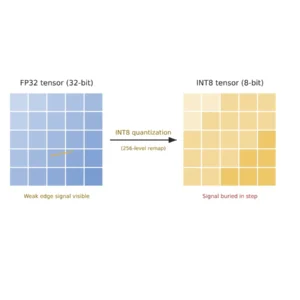
Why the Faintest Scratch Disappears First Under INT8 Quantization
Move a plated connector-pin detector to INT8 and overall accuracy may shift only 0.3 points while missed faint scratches quadruple. The brightest glint sets the step size, and lighting, calibration choice and enough…
-
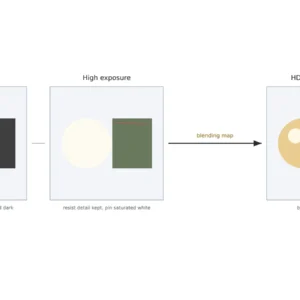
What HDR Multi-Exposure Fusion Does When Specular and Matte Share One Frame
A 249-to-1 pin-to-resist ratio fits a 66 dB sensor, yet a resist defect shot in one frame reaches a CNR of only 0.65. Dark-side defect contrast, more than dB, sets the frame count;…
-
Why Fewer False Alarms Matter More Than Faster Detection in Edge Fire-Detection AI
Of a 65% shorter detection time and 80% fewer false alarms, the false alarms move the site. With 40 cameras assumed, even after the cut 2,920 false alarms trail each real fire, so…
-
How Strongly Cross-Polarization Suppresses Glare Depends on the Lighting Angle
Cross-polarization presses nickel-pin highlights to 1/500 under coaxial light, but polarization leaks on curved pins under a 15° ring and suppression stops at 1/36.5. The price is 2.5 stops of light, and aligning…