Vision Algorithm
This section covers the rules and models that pick defects out of an image, and the cost when a decision is wrong: how rule-based and deep-learning methods share the work, anomaly detection, and filter order. It is the stage that turns the image made by lighting and optics into a pass/fail decision.
Start with these
- Deep Learning vs. Rule-Based Algorithms, When to Use Which — the conditions that favor each
- Overdetection or Missed Detection, Which One Costs More? — setting the decision line by cost
- Building a Vision Inspection App with PySide6 and OpenCV — full code for a minimal UI that tunes parameters on screen
- Must Every Normal Patch Be Remembered? — coreset design for memory-bank anomaly detection
Unfamiliar terms are explained in the Glossary, and a reading order across topics is in the Start Here guide.
-
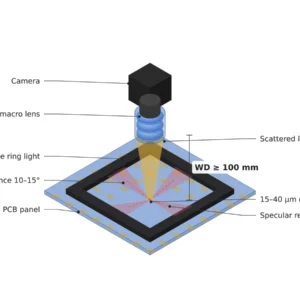
The 15 to 40 µm Boundary the Human Eye Misses in PCB and Semiconductor Surface Inspection
20/20 vision separates 72.7 μm at 250 mm. Catching 15 to 40 μm defects by machine takes 8 μm per pixel and a narrow aperture window of f/4 to f/5.6, and the lower…
-
Edge AI Inference Latency Is Set by the Camera Interface Before the NPU
An NPU twice as fast cuts decision latency only from 21.2 ms to 17.2 ms, because the 10.7 ms a 12 MP frame spends crossing 10GigE is half the total. What RDMA, link…
-
Why a Line-Scan Camera Chosen by Line Rate Alone Misses Defects
Line rate is speed divided by pixel size: 40 kHz at 400 mm/s and 10 μm. 64 TDI stages stretch exposure to 1.6 ms but smear 0.64 pixel at a 1 % speed…
-
Can One Focus Plane Keep Parts of Every Height Sharp?
One frame covering a 0.5 mm pin-height spread needs f/16, where the diffraction MTF for a 20 μm crack falls to 0.24. Two frames at f/8 or three at f/5.6 keep 0.60 to…
-
On Reflective Surfaces, a Bilateral Filter Keeps the Crack a Gaussian Blurs Away
At 10 μm/px a 3×3 median keeps nearly all the contrast of a 40 μm particle, but a 5×5 leaves only 12.8 to 23.2 GV. A 15 μm crack keeps 8.3 GV after…
-
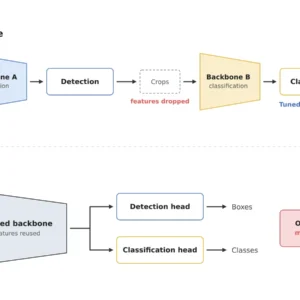
The Price of KLA’s Patent That Puts Detection and Classification in One Network
When detection and classification share a backbone, 50 candidates per frame drop from 240 ms to 55 ms, but a retrain that adds a new type shakes detection recall too. Telling a 5-point…
-
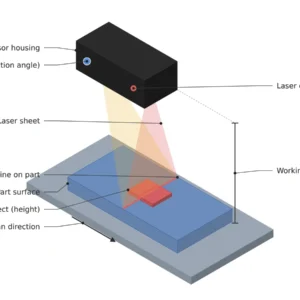
When 3D+AI Inspection Answers the Shape Defects 2D Can’t Catch
A 20 μm lift on a chip part leaves almost no contrast in a photo from above, but a 3D sensor viewing the laser at 30° reads it with 3.9 μm height resolution.…
-
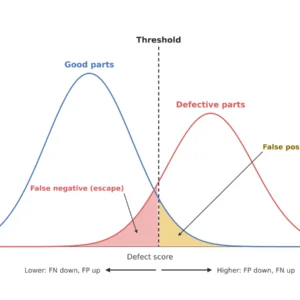
Overdetection or Missed Detection, Which One Costs More?
Even if one escape costs 100 re-inspections, at a 0.3% defect rate the threshold only drops from 0.583 to 0.487. Stopping 1.6 escapes a day costs 95 re-inspections, and a light dimmed by…
-
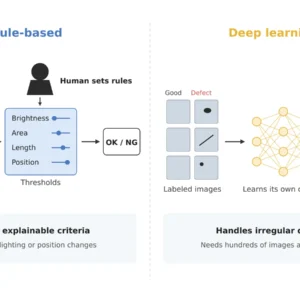
Deep Learning vs. Rule-Based Algorithms, When to Use Which
With one camera, subpixel rules measure the hole diameter in 1.6 μm steps, and learning takes the scratches whose shape keeps changing. If the rarest scratch type is 10% of defects, 300 training…