Vision Algorithm
This section covers the rules and models that pick defects out of an image, and the cost when a decision is wrong: how rule-based and deep-learning methods share the work, anomaly detection, and filter order. It is the stage that turns the image made by lighting and optics into a pass/fail decision.
Start with these
- Deep Learning vs. Rule-Based Algorithms, When to Use Which — the conditions that favor each
- Overdetection or Missed Detection, Which One Costs More? — setting the decision line by cost
- Building a Vision Inspection App with PySide6 and OpenCV — full code for a minimal UI that tunes parameters on screen
- Must Every Normal Patch Be Remembered? — coreset design for memory-bank anomaly detection
Unfamiliar terms are explained in the Glossary, and a reading order across topics is in the Start Here guide.
-
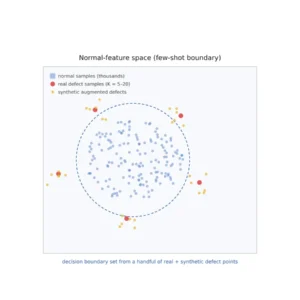
Can Five Defect Samples Stand Up a Few-Shot Anomaly Detection Line?
Catch all five defects and the 95 % lower bound on recall is still 55 %; claiming 95 % takes 59. What few-shot anomaly detection can set up, what it cannot prove, and…
-
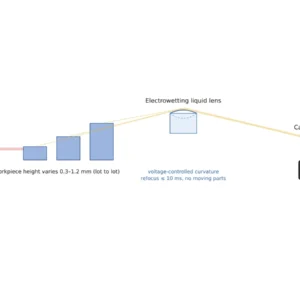
How Liquid Lens Autofocus Solves Focus on High-Mix, Low-Volume Lines
On a line mixing chip heights from 0.3 to 1.2 mm, a liquid lens needs less than 0.1 D of change. Worked out here: the resolution fixed focus loses, ±0.023 D repeatability, a…
-
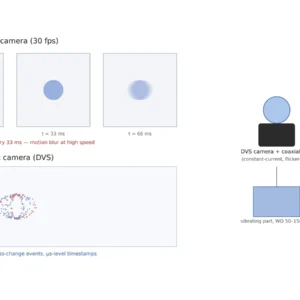
Catching the Moment Frames Miss with an Event Camera
A 200 fps camera misses 70 % of 0.5 ms events. Using a bouncing solder ball, this works out how fast an event camera pixel can follow, when PWM lighting overflows the sensor…
-
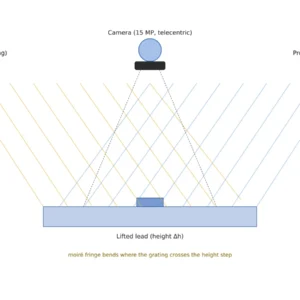
How 3D Structured Light Measures a Solder Lead Lift That Brightness Cannot Show
A lead lifted 30 μm parallel to its pad leaves no trace in 2D brightness but shifts projected fringes by 15.6°. The fringe strength that 3 μm repeatability takes, why shiny fillets lose…
-
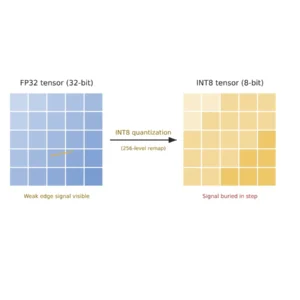
Why the Faintest Scratch Disappears First Under INT8 Quantization
Move a plated connector-pin detector to INT8 and overall accuracy may shift only 0.3 points while missed faint scratches quadruple. The brightest glint sets the step size, and lighting, calibration choice and enough…
-
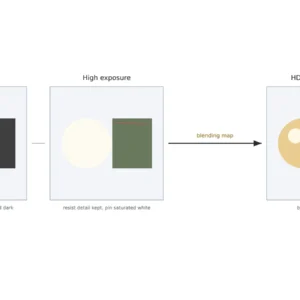
What HDR Multi-Exposure Fusion Does When Specular and Matte Share One Frame
A 249-to-1 pin-to-resist ratio fits a 66 dB sensor, yet a resist defect shot in one frame reaches a CNR of only 0.65. Dark-side defect contrast, more than dB, sets the frame count;…
-
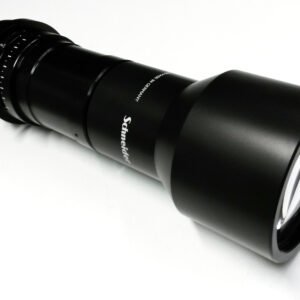
When Height Varies, F7.1 Beats F16 on a Telecentric Lens
With part height wobbling ±0.15 mm, a 20 μm defect peaks at 70 % MTF at an object-side NA of 0.042; closing to F16 for depth drops even in-focus contrast to 54 %.…
-
The Cost of Switching Between Dark-Field and Coaxial with Software-Defined Lighting
Under coaxial light, nickel-plated terminals and matte molding differ 398 to 1 in brightness, too wide for one exposure. Switching dark field, coaxial and dome in turn from one head adds 16.7 ms…
-
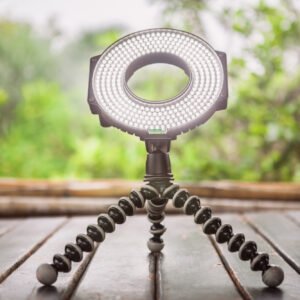
A Dark-Field Ring Light Tolerates Far More Tilt Than Coaxial Light
On a glossy molded housing under coaxial light, the background goes dark past a 0.86° tilt. A 15° dark-field ring widens that to 36.6°, and a ring radius near five times the field…
-
What Optical Design Needs to Not Miss Defects on a High-Speed Line
A 40 μm scratch on a part passing at 1 m/s stays within one pixel of smear only if the light stops within 13.3 μs, and the 7.5-fold light shortfall splits into 2…