Optics
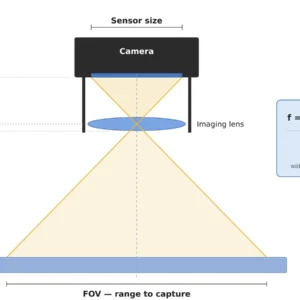
This section covers the values that are settled by calculation first: the size of one pixel on the object, working distance (WD) and depth of field. How many pixels a defect occupies on screen is decided by these numbers before any algorithm runs.
Start with these
- How to Calculate Machine-Vision Lens Focal Length — the basic formula from FOV, WD and sensor size
- Machine Vision Lens Calculator — where the shortcut formula breaks at higher magnification, plus depth of field and diffraction
- Vision Types Split First by Wavelength and Pixel Size — several vision methods compared in one table
- In SWIR, One Stop Down Erases a 3.4 µm Pixel — how diffraction covers a pixel as wavelength grows
Unfamiliar terms are explained in the Glossary, and a reading order across topics is in the Start Here guide.
-
Keeping Frame Rate and Lighting from Colliding on a High-Speed Inspection Line
Tighten the defect limit from 60 μm to 15 μm on a 1.1 m/s line and frames go from 29.8 to 119.4 fps, the strobe width limit falls to 4.55 μs, the light…
-
When You Add Cameras to a Semiconductor or PCB Line, the Interface Rewrites the Optics
A 5,120 px camera that puts a 10 μm defect into three pixels makes 26.2 MB frames, so 1 GigE tops out at 4.8 frames per second, and 2.5 μm pixels narrow the…
-
Why a Line-Scan Camera Chosen by Line Rate Alone Misses Defects
Line rate is speed divided by pixel size: 40 kHz at 400 mm/s and 10 μm. 64 TDI stages stretch exposure to 1.6 ms but smear 0.64 pixel at a 1 % speed…
-
Can One Focus Plane Keep Parts of Every Height Sharp?
One frame covering a 0.5 mm pin-height spread needs f/16, where the diffraction MTF for a 20 μm crack falls to 0.24. Two frames at f/8 or three at f/5.6 keep 0.60 to…
-
On Reflective Surfaces, a Bilateral Filter Keeps the Crack a Gaussian Blurs Away
At 10 μm/px a 3×3 median keeps nearly all the contrast of a 40 μm particle, but a 5×5 leaves only 12.8 to 23.2 GV. A 15 μm crack keeps 8.3 GV after…
-
Why a PCB Micro-Crack Revealed by Multi-Angle Lighting Vanishes in a Downscaled AI Input
A 30 μm crack on three pixels needs a 4,096 px image, and a 960 px model input shrinks it to 0.70 pixels. With 20 native tiles and a 100 ms budget, fusing…
-
In PCB Inspection, the Lens Comes Before the AI
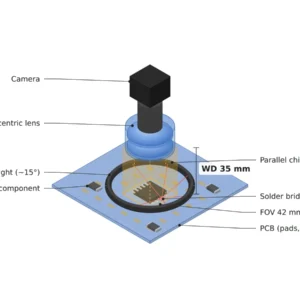
A conventional lens viewing a 42 mm field from 150 mm looks 8.0° off vertical at the edge, hiding 0.28 mm beside a 2 mm tall part. A 25 μm bridge in that…
-
In the Age of 8K Line-Scan Cameras, the Lens Still Sets the Ceiling on Inspection Resolution
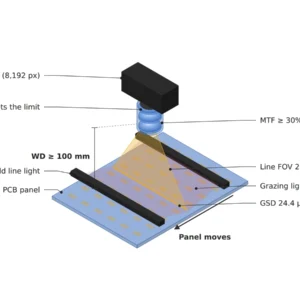
At a 200 mm view, 8K puts a 50 μm bridge on 2.05 pixels and the lens needs an MTF of 0.33 at 34.9 lp/mm. At f/8, which covers 1.5 mm of warp,…
-
The Defect Zone You Miss When You Switch to 3D Inspection
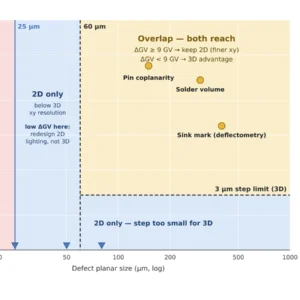
A 2D line-scan at 8.33 μm/px has a 25 μm planar floor; a 3D profiler at 20 μm/px xy has 60 μm. Defects in between shrink to 1.3 to 2.75 pixels in 3D,…
-
How to Calculate Machine-Vision Lens Focal Length
For 100 mm across at a 200 mm WD, the shortcut points to a 12.8 mm lens, but a 12 mm lens mounted as is leaves only 0.13 mm of margin per side…