Optics
This section covers the values that are settled by calculation first: the size of one pixel on the object, working distance (WD) and depth of field. How many pixels a defect occupies on screen is decided by these numbers before any algorithm runs.
Start with these
- How to Calculate Machine-Vision Lens Focal Length — the basic formula from FOV, WD and sensor size
- Machine Vision Lens Calculator — where the shortcut formula breaks at higher magnification, plus depth of field and diffraction
- Vision Types Split First by Wavelength and Pixel Size — several vision methods compared in one table
- In SWIR, One Stop Down Erases a 3.4 µm Pixel — how diffraction covers a pixel as wavelength grows
Unfamiliar terms are explained in the Glossary, and a reading order across topics is in the Start Here guide.
-
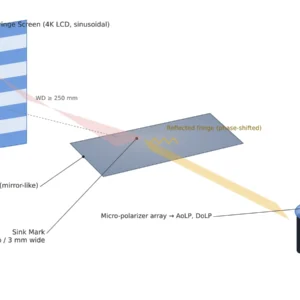
Catching 20 μm Sink Marks on High-Gloss Molded Parts with Phase Measuring Deflectometry
A sink mark 20 μm deep and 3 mm wide tilts the surface by 20.9 mrad, which moves the reflected fringes 16.8 mm on a screen 400 mm away. A 2.9 mm defocus…
-
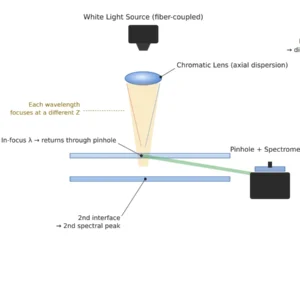
The Error Frame Temperature Leaves in Two-Sided Chromatic Confocal Thickness Measurement
A 1 K change in the steel frame between two heads moves the thickness reading by 1.17 μm. How two-channel, two-sided chromatic confocal measurement removes the refractive index, and how heat, tilt and…
-
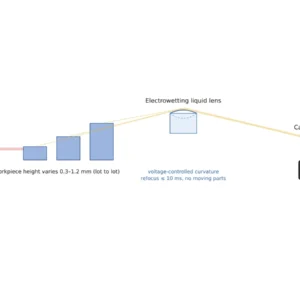
How Liquid Lens Autofocus Solves Focus on High-Mix, Low-Volume Lines
On a line mixing chip heights from 0.3 to 1.2 mm, a liquid lens needs less than 0.1 D of change. Worked out here: the resolution fixed focus loses, ±0.023 D repeatability, a…
-
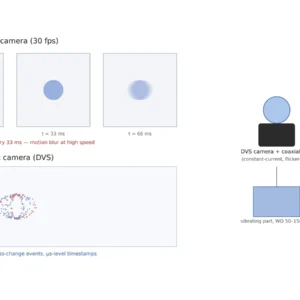
Catching the Moment Frames Miss with an Event Camera
A 200 fps camera misses 70 % of 0.5 ms events. Using a bouncing solder ball, this works out how fast an event camera pixel can follow, when PWM lighting overflows the sensor…
-
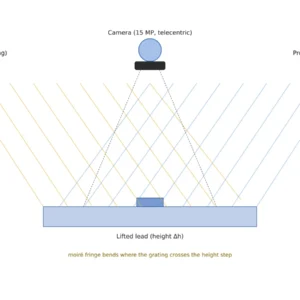
How 3D Structured Light Measures a Solder Lead Lift That Brightness Cannot Show
A lead lifted 30 μm parallel to its pad leaves no trace in 2D brightness but shifts projected fringes by 15.6°. The fringe strength that 3 μm repeatability takes, why shiny fillets lose…
-
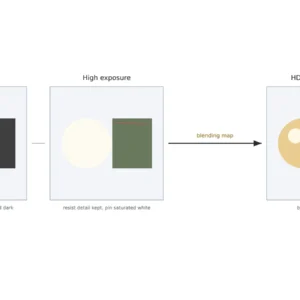
What HDR Multi-Exposure Fusion Does When Specular and Matte Share One Frame
A 249-to-1 pin-to-resist ratio fits a 66 dB sensor, yet a resist defect shot in one frame reaches a CNR of only 0.65. Dark-side defect contrast, more than dB, sets the frame count;…
-
How Strongly Cross-Polarization Suppresses Glare Depends on the Lighting Angle
Cross-polarization presses nickel-pin highlights to 1/500 under coaxial light, but polarization leaks on curved pins under a 15° ring and suppression stops at 1/36.5. The price is 2.5 stops of light, and aligning…
-
When Height Varies, F7.1 Beats F16 on a Telecentric Lens
With part height wobbling ±0.15 mm, a 20 μm defect peaks at 70 % MTF at an object-side NA of 0.042; closing to F16 for depth drops even in-focus contrast to 54 %.…
-
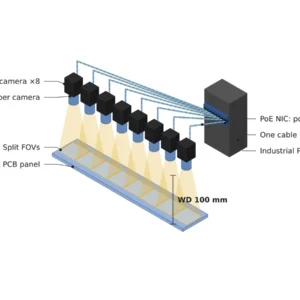
Why the PoE Network Card Sets the Limit on Your Optical Setup in a Multi-Camera Inspection Line
Putting 30 μm defects into three pixels takes four cameras on each side of the PCB, eight in all. At 100 MB/s each, a single switch with one 1 GigE link to the…
-
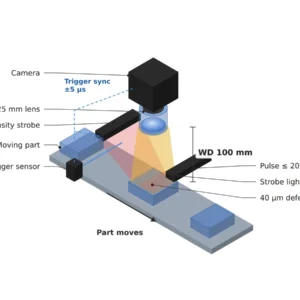
What Optical Design Needs to Not Miss Defects on a High-Speed Line
A 40 μm scratch on a part passing at 1 m/s stays within one pixel of smear only if the light stops within 13.3 μs, and the 7.5-fold light shortfall splits into 2…