Lighting Design
With the same camera, a defect can appear or vanish depending on the angle and wavelength of the light. This section collects articles on choosing among coaxial, dome, dark-field and backlight methods, and on handling reflection, wavelength and brightness drift.
Start with these
- Six Machine-Vision Lighting Methods and How to Choose — how each method works and the order for choosing
- For Scratches on Highly Reflective Metal, Choose the Lighting First — a lighting map by surface type
- Why a Black Spot Remains in the Center of a Dome Light — the viewing-hole dark spot and fill light
- When the Light Dims by 5 %, How Many Good Pixels Turn Into Defects? — how brightness change affects decisions
Unfamiliar terms are explained in the Glossary, and a reading order across topics is in the Start Here guide.
-
In SWIR Imaging, Lighting and Aperture Keep the Defect Contrast
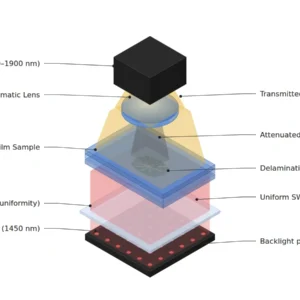
Film lifting in a film insert molded cover darkens by 7.7 % in SWIR transmission but only by 3 % for a 0.1 μm gap, and at 1,450 nm a 3.45 μm pixel…
-
How Strongly Cross-Polarization Suppresses Glare Depends on the Lighting Angle
Cross-polarization presses nickel-pin highlights to 1/500 under coaxial light, but polarization leaks on curved pins under a 15° ring and suppression stops at 1/36.5. The price is 2.5 stops of light, and aligning…
-
The Cost of Switching Between Dark-Field and Coaxial with Software-Defined Lighting
Under coaxial light, nickel-plated terminals and matte molding differ 398 to 1 in brightness, too wide for one exposure. Switching dark field, coaxial and dome in turn from one head adds 16.7 ms…
-
A Dark-Field Ring Light Tolerates Far More Tilt Than Coaxial Light
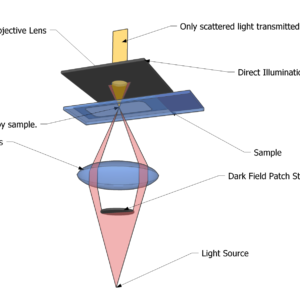
On a glossy molded housing under coaxial light, the background goes dark past a 0.86° tilt. A 15° dark-field ring widens that to 36.6°, and a ring radius near five times the field…
-
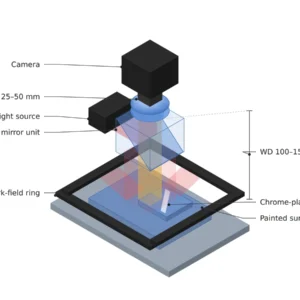
In Automotive Part Appearance Inspection, Lighting Design Comes First
Under a point source chrome plating and black paint sit 76,800 times apart, beyond 12 bits, but under a dome the ratio falls to 12. Paint scratches go to 15° low-angle light and…
-
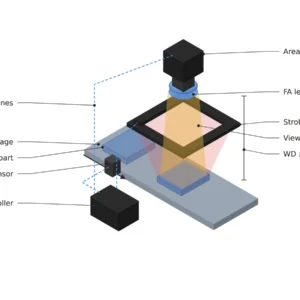
Keeping Frame Rate and Lighting from Colliding on a High-Speed Inspection Line
Tighten the defect limit from 60 μm to 15 μm on a 1.1 m/s line and frames go from 29.8 to 119.4 fps, the strobe width limit falls to 4.55 μs, the light…
-
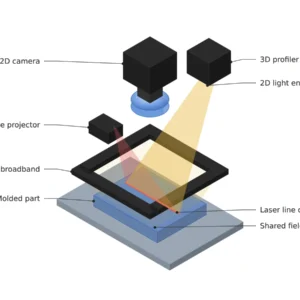
In 2D/3D Fusion Inspection, the Bottleneck Is Lighting Interference
When 2D lighting and a 3D laser share a band they must take turns, and a 3 ms gap at 200 mm/s leaves a 600 μm offset. Correcting it at nominal speed holds…
-
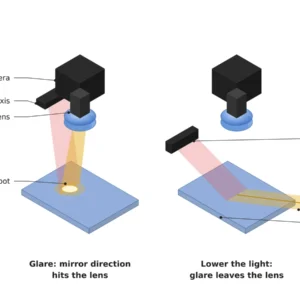
How to Handle Imaging on Highly Reflective Surfaces
Glare on a glossy surface leaves the frame once the light moves 14.8° off the axis; coaxial light costs 25 % of the light, cross-polarization 16 %, and four split shots 100 ms.…
-
Six Machine-Vision Lighting Methods and How to Choose
On a flat gold pad the camera records the mirror image of the light: a 30 mm ring at lens height reflects only on a 15 mm circle, and an 80 mm coaxial…