Lighting Design
With the same camera, a defect can appear or vanish depending on the angle and wavelength of the light. This section collects articles on choosing among coaxial, dome, dark-field and backlight methods, and on handling reflection, wavelength and brightness drift.
Start with these
- Six Machine-Vision Lighting Methods and How to Choose — how each method works and the order for choosing
- For Scratches on Highly Reflective Metal, Choose the Lighting First — a lighting map by surface type
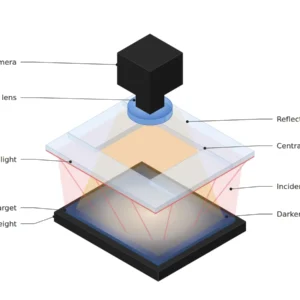
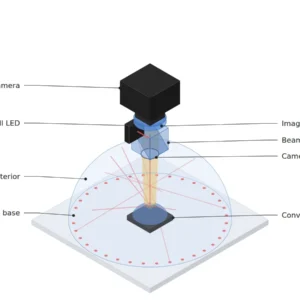
- Why a Black Spot Remains in the Center of a Dome Light — the viewing-hole dark spot and fill light
- When the Light Dims by 5 %, How Many Good Pixels Turn Into Defects? — how brightness change affects decisions
Unfamiliar terms are explained in the Glossary, and a reading order across topics is in the Start Here guide.
-
Flat-Field Correction Gain Amplifies Noise Along with Uneven Light
Flat-field correction restores only the average brightness of the corners. A 1.67 gain on a corner getting 60 % of the light raises noise 1.29 times and the chance of crossing the same…
-
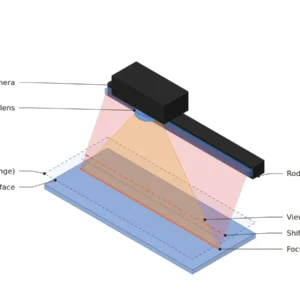
Why Are the Ends of a Line Scan Image Dark?
The ends of a line scan image sit at 0.77 of the center from cosine fourth falloff. A 1.3 gain fixes brightness but leaves SNR at 0.88, so shape the light 1.3 times…
-
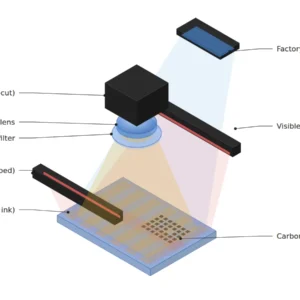
An 850 nm Band-Pass Filter Erases Factory Lights but Leaves Sunlight
An 850 nm band-pass filter erases factory LED light but keeps sunlight. What remains shrinks by the overdrive factor, not by the shorter exposure: a 40-level swing drops to 2 levels with the…
-
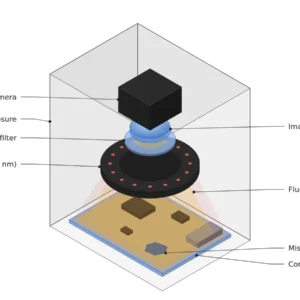
Gaps in a Clear Conformal Coating Show Up Under UV Fluorescence
A transparent coating reflects the same 4 % as bare solder mask, so white light cannot find it. Under 365 nm only its glow remains, but without an OD 4 long-pass and a…
-
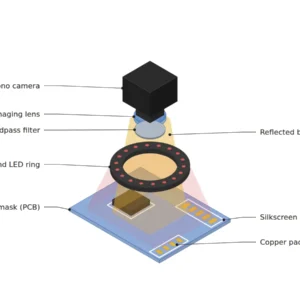
A Mono Camera Catches PCB Color Differences When You Choose the Wavelength
With 625 nm light on a mono camera, 80 μm of copper exposed through a green mask images at 4.9 px, while the red channel of the color version of the same sensor…
-
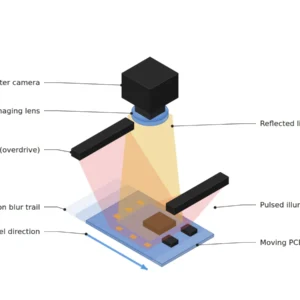
Moving Parts Are Frozen by How Long the Light Stays On
Imaging pins moving at 1,000 mm/s at 24.5 μm/px, keeping blur under 0.5 px means the light must go off within 12.25 μs. A 10 μs pulse at 4× overdrive leaves 0.4× the…
-
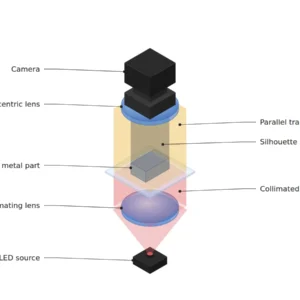
On Thick Parts, Silhouette Measurement Error Comes from the Backlight’s Angle
Gauge a 3 mm thick metal part on a diffuse backlight and the edge smears over 7.6 px; switch to collimated light with 0.29° divergence and it narrows to 1.5 px. In exchange,…
-
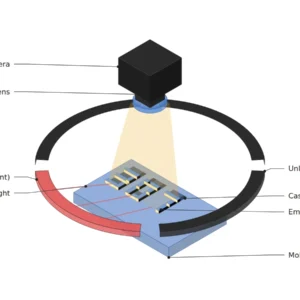
One Lighting Angle Decides the OCR Read Rate on Molded Characters
Molded characters 50 μm high with 300 μm stroke spacing read by their shadows only between 18.4° and 53.7° of elevation. Choosing 20° keeps them readable down to 13.4 μm of height, but…
-
The Black Spot in the Middle of a Dome Light Is the Camera Hole
Image a plated cap with a 6 mm radius of curvature in a dome 180 mm across and the reflected camera hole leaves a 0.53 mm dark spot covering 81 px. Cutting the…
-
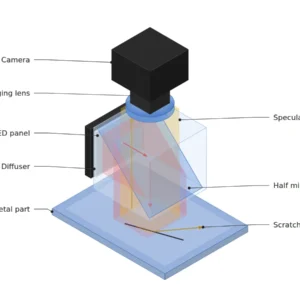
Coaxial Light Alone Does Not Settle Fine Scratches on Polished Metal
Turn on collimated coaxial light over polished metal and only 31.8% of a 75 mm lens field lights up, while a 1° tilt shifts the bright circle 7.2 mm. Add a diffuser and…